
1 MINUTE READ
Will Ozempic be good for the planet?
GLP-1 drugs like Ozempic are already changing how much – and what – millions of people eat.
In the US alone, households with a GLP-1 user have cut more than $9bn a year from their grocery bills: more than the entire world spends on plant-based meat. Yet many food businesses haven’t asked what this means for their emissions, targets and strategy.
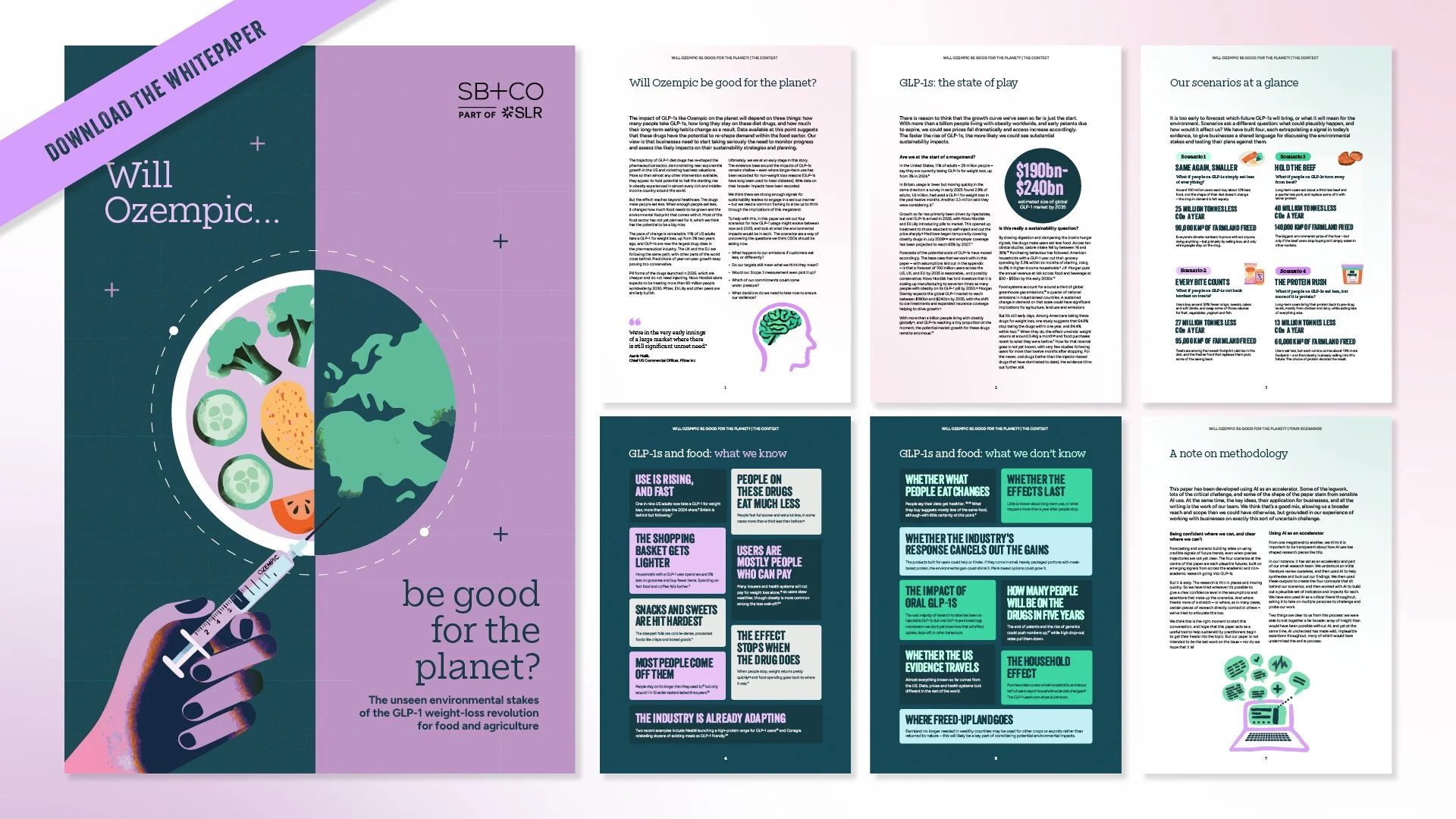
Our new whitepaper sets out four scenarios for how GLP-1 use could reshape food demand by 2035, and what each would mean for the planet.
In the biggest of these scenarios, GLP-1s take around 40 million tonnes of CO₂e a year out of the food system across the US, UK and EU – nearly a fifth of the average user’s food footprint – and free up farmland the size of England. In another, a shift towards animal protein halves the saving.
It’s early days, so the scenarios build on emerging signals rather than forecasts. They show sustainability leaders what’s worth doing now, which signals to watch, and where their targets and Scope 3 numbers could start to mislead them.
Download the whitepaper to begin to think about how your plans stack up against all four scenarios.
Download the PDF
Complete the form below to get the download
Get in touch:
Senior Communications Director | SB+CO
Senior Communications Consultant | SB+CO