
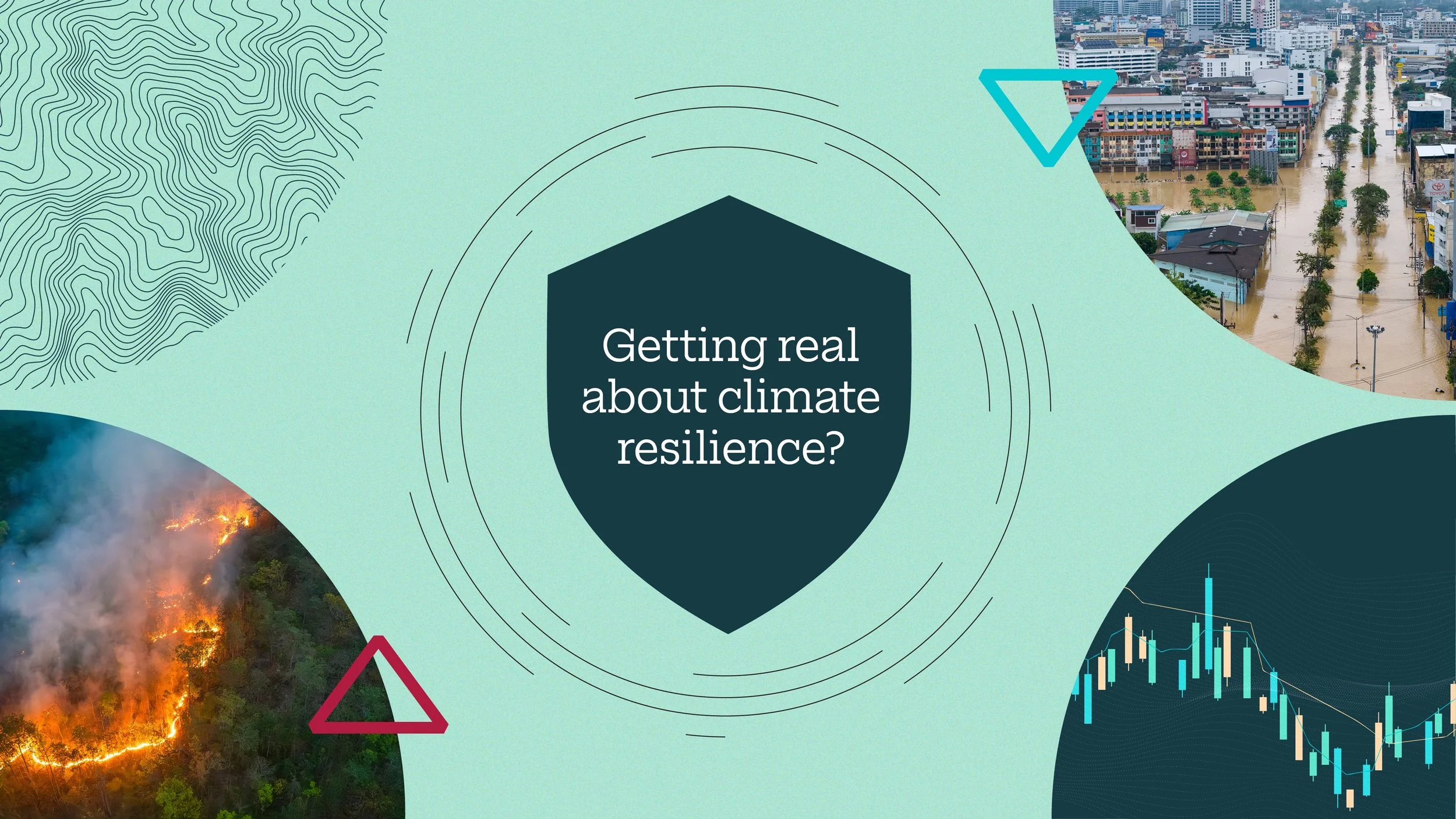
2026: The year businesses get real about climate resilience?
5 MINUTE READ | BY KATE JONES AND PHOEBE IRELAND-JONES | 16TH MARCH 2026
We’ve spent the last decade modelling climate risk. But in many businesses, the translation into meaningful adaptation and resilience investment is still catching up.
Climate disruption is no longer theoretical. Extreme heat is reducing productivity.¹ Storms are interrupting logistics.² Insurance premiums are rising.³ These aren’t distant 2050 scenarios; they’re operational realities affecting business performance today. Following our climate resilience webinar in early February, we’ve taken a moment to reflect on what we’re seeing across the market.
Over the last decade, climate risk reporting has become standard practice for the majority of large businesses, guided by frameworks such as the Task Force on Climate-related Financial Disclosures (TCFD) and the International Sustainability Standards Board (ISSB). While this has created a common language of climate risk within businesses, and strengthened governance and transparency around it, we often see it treated as a long-term scenario-driven reporting exercise. Climate scenario analysis plays an important role in stress-testing potential futures, but we’re seeing that it doesn’t always translate into action to manage today’s rising costs and disruption.
“65% of businesses lack an adaptation plan to address the physical impacts of climate change.”⁴
Part of this gap is due to the theoretical nature of climate scenarios. Using assumptions, estimates and forecasting can provide a strong macro-view on what climate risks could look like. But they often lack the certainty businesses need to justify large investments in resilience and adaptation measures.
But we’re starting to see a shift in approach, primarily because of the increasingly real impacts on company bottom lines and climate resilience.⁵ Stronger business cases for action are being created by paying more attention to the immediate effects of climate change.
We’re seeing three emerging trends across the market:
1. Reframing language using ‘resilience’ as the anchor
“We’re framing our environmental work around reducing our climate impact because it ultimately supports the resilience of the business.”
Quotes anonymised from recent client conversations
Rather than positioning climate action solely through a sustainability lens, we are seeing businesses reframing their broader sustainability agenda as a business resilience strategy. This language of “resilience” shifts the conversation more quickly toward commercial territories. This reflects a broader effort by many sustainability functions to reshape perceptions following a period of significant uptick in sustainability regulation, which has often positioned sustainability as a compliance-driven cost centre.
A resilience narrative helps reposition the function as central to commercial and strategic decision-making and resonates more with non-sustainability senior leaders. In private equity and investment contexts especially, we’re seeing climate framed in terms of asset resilience and the returns an investment delivers once risks are taken into account.
2. Measuring climate risk in real time.
“Making the commercial case isn’t always straightforward, but strong analytics presented in a clear, practical way helps drive buy-in across the organisation.”
Quantifying the potential financial impacts of climate risks and opportunities can be complex and reliant on estimates and assumptions, often meaning the resulting figures are too hypothetical for businesses to act on. Perhaps, then, the most tangible shift we’re seeing is businesses move beyond modelling distant futures towards asking far more practical questions: how did climate disruption actually affect us last year? Which sites or suppliers were most affected? Where did we see downtime? Are we investing in the right places to reduce that exposure? What costs are we incurring?
Many of our clients are instead developing a focused set of KPIs grounded in actual data and real impacts, rather than long term projections. This approach is gaining traction amongst sustainability teams in building credible business cases for resilience investment. Advanced climate risk tools are also helping businesses manage climate complexity at scale, making insights more practical and enabling collaboration across teams.
3. Drilling down to asset-level action.
“Climate risk is forcing us to ask harder questions about our assets… are we investing in the right sites, and are we protecting them as best as possible?”
After identifying climate risks, a common challenge we see is deciding where to act. An effective approach is to focus first on material exposure: identify the assets or locations within your operations and supply chain most vulnerable to near-term climate hazards, then dive deeper where risk is highest. This helps businesses to focus investment where it will have the greatest impact.
A question we’re often asked is how to manage high-impact, low-probability events (such as extreme heat exceeding infrastructure design limits). This is where clarity around risk appetite becomes essential - determining which risks need mitigation now and which should be monitored over time. Rather than reacting to every modelled outcome, we’re seeing businesses prioritise targeted near-term action while tracking how climate risks and business footprints evolve.
What might come next
Our approach to climate risk needs to reflect the changing reality of climate impacts. As organisations begin translating climate risk insight into practical action, we are seeing early signals of how climate resilience is becoming embedded into strategy and long-term performance.
The emerging signals include:
Climate resilience becoming a core theme within transition plans, helping to secure budget, align priorities and guide capital allocation. This presents opportunities to unlock co-benefits, including positive outcomes for nature and communities. Anglo American’s Climate Transition Plan provides an example of this. It emphasises adaptation plans across sites and prioritises investments that strengthen the resilience of its portfolio to climate impacts.⁶
Evolving compliance expectations, such as IFRS S2, pushing companies to demonstrate how climate risk is already affecting financial performance and capital allocation today.
If this is relevant to how you’re thinking about building resilience, please do reach out. We’d love to chat to you.
Footnotes:
World Health Organization & World Meteorological Organization – Climate change and workplace heat stress: https://www.who.int/news/item/22-08-2025-who-wmo-issue-new-report-and-guidance-to-protect-workers-from-increasing-heat-stress
Munich Re – Super typhoon disrupts supply chains: https://www.munichre.com/rmp/en/the-re-brief/risk-management/super-typhoon-disrupts-supply-chains-shipping-and-holiday-shopping.html
World Economic Forum – Climate disasters and the growing global insurance protection gap: https://www.weforum.org/stories/2025/08/global-insurance-industry-gap/
S&P Global – Climate costs are rising, but few companies have an adaptation plan: https://www.spglobal.com/en/research-insights/special-reports/look-forward/climate-costs-are-rising-but-few-companies-have-an-adaptation-plan
World Economic Forum – The resilience imperative: Why companies must adapt to a +1.5°C world: https://www.weforum.org/stories/2025/06/the-resilience-imperative-why-companies-must-adapt-to-a-1-5-degrees-world/
Anglo American Transition Plan 2026-2028: https://www.angloamerican.com/~/media/Files/A/Anglo-American-Group-v9/PLC/sustainability/health-environment/climate-change/climate-transition-plan-2026-2028.pdf

Kate Jones
Sustainability Strategy Director - Climate Lead

Phoebe Ireland-Jones
Senior Analyst
Get in touch
Find out how SB+CO’s sustainability experts can help your company.